It started with marshmallows. Which is probably not how most sports nutrition companies begin.
Or, more accurately, it started with hating gels.
I hated gels. Still do. And at some point it occurred to me that a gel is just sugar. So I started wondering whether there was a more fun way to eat sugar during a race. My first attempt was a marshmallow.
I tried different recipes. I freeze-dried them. That produced these fantastic little carbohydrate puffs that practically dissolved in your mouth.
They were also enormous.
Not exactly the breakthrough in endurance nutrition I had imagined. But I’m getting ahead of myself.
I am not an elite athlete.
My running career began in junior high because my best friend joined the cross-country team. He joined, at least in part, because he was trying to convince some cute girls to join. These were not exactly the origins of an Olympic dream.
I ran for two years. I enjoyed it. I was reasonably good at it. My final race was probably my best: I finished ninth at our regional meet, earned a little top-ten ribbon, and broke ten minutes for the first time in the 1.5 mile distance. Baller.

Then I went to high school and stopped running. Basketball was more my thing, along with some football, golf, and whatever else was on offer.
Then, around 2020, I started running again, and eventually I got the idea that I should run farther.
That’s where things started going poorly.
It turns out I’m an extraordinarily mediocre distance runner.
I got injured, then I got injured again, and somewhere in there I discovered that my stomach has an impressive ability to reject nearly every circumstance associated with endurance exercise.
Run too fast? Nauseous. Run too far? Nauseous. Too hot? Nauseous. Altitude? Nauseous. Eat too much? Nauseous. Eat too little? Also nauseous. Wrong gel? You get the idea.
That introduced me to one of the great rites of passage in endurance sports: learning how to fuel by doing nearly everything wrong first. You hear that you should eat during a race, so you buy some gels. Then you discover that gels are, at least to some of us, deeply unpleasant little packets of goo. You start hearing about grams of carbohydrate per hour, sodium, glucose, fructose, hydration, gut training, ratios.
None of it is individually that complicated. But somehow, when you’re new to endurance sports, fueling feels mysterious. So I started messing around.
First came the kitchen experiments.
Marshmallows. Freeze-dried marshmallows. Candy. Homemade gels. Drink mixes. Different carbohydrate sources, different textures, different ways of getting calories into my body without making my stomach revolt. I actually still like and use some of these strategies. Most of these experiments went nowhere.
But something interesting happened along the way.
I stopped asking what food I’d rather eat during a race, and started asking what the actual problem was that we were trying to solve.
That’s a more useful question than it sounds, because in my day job, I’m a researcher. I’m a pharmacist by training and a faculty member whose primary research is actually cardiovascular disease and hypertension. I’m not an exercise physiologist or a sports dietitian. I’m not a running coach. But I do know how to do one thing particularly well: interrogate a scientific question.
So endurance fueling became a research rabbit hole. What actually happens when we consume carbohydrate during exercise? Why glucose and fructose, and why those particular ratios? Where did our carbohydrate-per-hour targets even come from, and what happens to them as duration increases? What does the evidence actually demonstrate, and where have marketing departments run considerably farther than the data?
The more I learned, the more interesting the problems became. And eventually my kitchen wasn’t enough.
A pharmacist and a materials scientist walk into a lab…
I reached out to Dr. Jeffrey Bates, a professor at the University of Utah whose expertise in materials science included work relevant to hydrogels. The message I sent him was roughly: “I’ve been messing around with some weird materials in my kitchen. You actually know what you’re doing. Want to talk?”
Fortunately, he did.
That conversation became a collaboration. As it turned out, Jeff already had experience commercializing university research, and he was the one who first suggested that commercialization might be the way to fund the research I actually wanted to do. He introduced me to grant opportunities and to the university’s programs for helping researchers turn their work into companies.
We started doing customer discovery with endurance athletes, talking about fueling across everything from marathons to multi-day ultramarathons. We listened to what worked, what didn’t, what athletes tolerated, what they hated, and what problems existing products weren’t solving. And we started doing actual R&D.
We applied for a National Science Foundation Small Business Innovation Research grant. We didn’t get it. We will apply again. That’s part of the story too. But the University of Utah’s Technology Licensing Office saw enough potential to fund a University research project led by Jeff and me, and we’ve continued building from there.
Today, we have multiple ideas and technologies at different stages of development. Some are getting closer. Others are still very much research projects. There are things we’re extremely excited about, and unfortunately, I can’t tell you much about them yet.
Which creates a slightly ridiculous problem for a startup: how do you build a company around products you can’t sell, or even fully talk about, yet?
So we’re starting with something simple.
FKT Labs’ first products aren’t going to revolutionize carbohydrate metabolism, and we’re not going to pretend they do. We’re starting with straightforward endurance-fueling products based on established principles, while we continue doing the slower, harder work of developing genuinely new technology. That’s intentional.
I’m learning how to take science out of a laboratory and turn it into a company. I’m beginning the Master of Business Creation program at the University of Utah, learning manufacturing, formulation, commercialization, branding, distribution, intellectual property, and approximately 400 other things I didn’t know I needed to know.
So this is the beginning: the messy part, not the polished retrospective that shows up once everything’s worked out.
And that’s what I want FKT Labs to be about.
There are already a lot of endurance nutrition companies. We do not need another one putting familiar ingredients into a package and inventing increasingly elaborate reasons they’re revolutionary.
As I started doing market research, I found dozens of companies selling energy gels and other carbohydrate products. Even though they were all using the exact same ingredients, their marketing claims all seemed to read like some version of this:
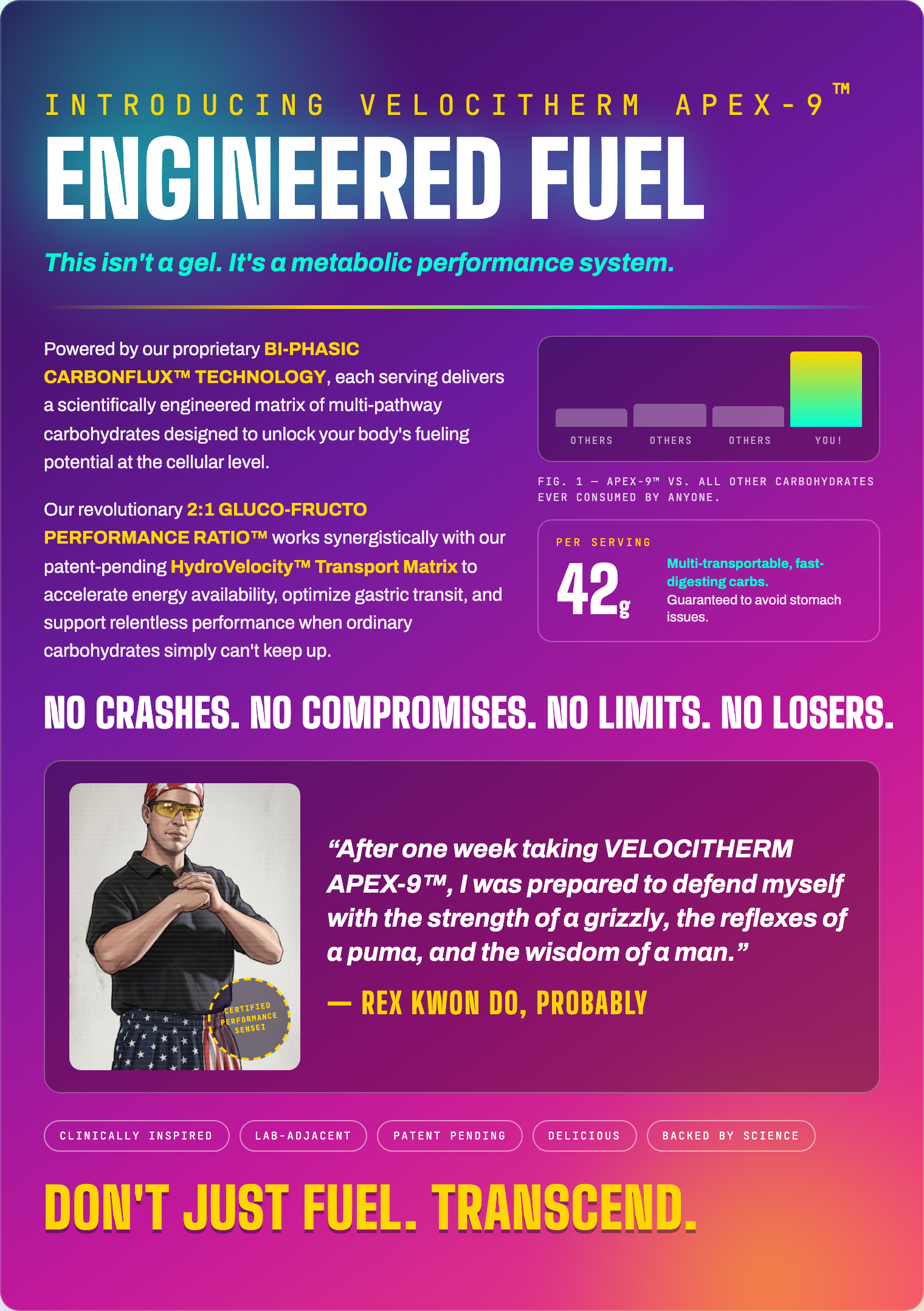
That’s a lot of hype for something that is functionally equivalent to mixing table sugar, salt, and water. There’s nothing wrong with glucose and fructose. In fact, there’s good evidence supporting their use. So why do we feel compelled to make basic carbohydrate chemistry sound like technology recovered from an alien spacecraft?
What I hope we can build instead is a company that’s unusually comfortable telling the truth. Sometimes the science is exciting, and sometimes it’s inconclusive. Sometimes an expensive ingredient is genuinely worth it, and sometimes glucose is just glucose. We want to help athletes understand the difference.
We want to dig into papers, examine interesting questions, show data, challenge our own assumptions, and make the science of endurance fueling more accessible. We want to build genuinely innovative products. And when we’re selling something that isn’t innovative, we want to be equally straightforward about that.
No magic, no proprietary-sounding explanation of basic physiology, just a good product, at a fair value, designed around what the evidence actually supports.
This is an experiment.
FKT Labs is a company, but right now it also feels very much like an experiment. Can we build better ways to fuel endurance athletes? Can we make the science easier to understand without turning every finding into a marketing claim? And can a mediocre runner with a weak stomach, a research background, and a willingness to make marshmallows in the name of science actually turn an idea into a business?
I don’t know. That’s part of the fun.
We’re going to do research, build things, make mistakes, and talk about what we learn. And, hopefully, we’ll help some people reach goals that matter to them along the way.
And yes, if this all somehow makes us wildly successful, I’m not going to complain about that either.
But first, we have some experiments to run.
We are either going to revolutionize endurance fueling, or this is going to be an absolute train wreck. Either way, you’re going to want to watch.
Welcome to FKT Labs.